

Distance Between Two Polar Coordinates
Distance between polar coordinates – Derivation, Process, and Examples
We can find the distance betwixt polar coordinates by revisiting the distance formula. Knowing this technique will come up in handy when we desire to find the distance betwixt 2 or more than polar coordinates, and we don't want to convert them into their rectangular forms.
Nosotros tin find the altitude between ii polar coordinates using the values of their radii and their arguments.
This commodity will show how nosotros tin can derive the polar coordinates' distance formula and larn how to apply information technology in different examples and problems. Earlier we do and so, brand sure to review your notes on the following:
- Make sure to understand the different components needed for us to apply the distance formula in rectangular coordinates.
- Review your knowledge of polar forms and converting rectangular expressions to their polar forms .
- Refresh your knowledge on the about mutual trigonometric identities yous've learned in the by.
Let's go alee and dive correct into the formula and the process of finding the distance between 2 or more polar coordinates.
How to find the distance between polar coordinates?
The all-time way to sympathize how we can apply the distance formula for polar coordinates is by deriving the formula from the distance formula for rectangular coordinates.
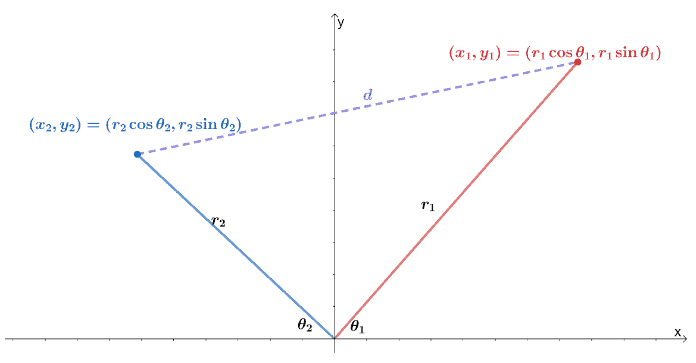
Hither's a visualization of how two polar coordinates be on an $xy$-coordinate system. Recall that the distance between 2 points, $(x_1, y_1)$ and $(x_2, y_2)$, is equal to $\sqrt{(y_2 – y_1)^2 + (x_2 – x_1)^ii}$.
Nosotros tin can express the two points as ii polar coordinates, $(r_1 \cos \theta_1, r_1 \sin \theta_1)$ and $(r_2 \cos \theta_1, r_2 \sin \theta_1)$. We tin then rewrite the altitude formula in terms of the radius and the statement of the polar coordinates.
\begin{aligned}d &= \sqrt{(y_2 – y_1)^2 + (x_2 – x_1)^2}\\d &= \sqrt{(r_2 \sin\theta_2 – r_1 \sin\theta_1)^2 + (r_2 \cos \theta_2 – r_1 \cos \theta_1)^two}\end{aligned}
We can expand the terms inside the square root using the algebraic property, $(a -b)^2 = a^2 -2ab + b^2$, and so simplify the terms as shown below.
\begin{aligned}d &= \sqrt{(r_2^{\phantom{x}2} \sin\theta_2 -two r_1r_2\cos\theta_1\sin\theta_2 + r_1^{\phantom{x}2} \sin^2\theta_1) + (r_2^{\phantom{x}2} \cos\theta_2 -two r_1r_2\sin\theta_1\cos\theta_2 + r_1^{\phantom{ten}2} \cos^2\theta_1)}\\&= \sqrt{ (r_1^{\phantom{x}2}\cos^two\theta_1 + r_1^{\phantom{x}2} \sin^ii\theta_1) + (r_2^{\phantom{x}ii}\cos^2\theta_2 + r_2^{\phantom{10}2} \sin^2\theta_2) -(ii r_1r_2\cos\theta_1\sin\theta_2 +2 r_1r_2\sin\theta_1\cos\theta_2) }\\&= \sqrt{ r_1^{\phantom{x}2} (\cos^ii\theta_1 + \sin^2\theta_1) + r_2^{\phantom{10}2}(\cos^2\theta_2 + \sin^2\theta_2) -2r_1r_2(\cos\theta_1\sin\theta_2 +\sin\theta_1\cos\theta_2) }\end{aligned}
Does pair wait familiar to yous? That's because we can rewrite them using the following trigonometric identities:
- $\sin^2 A + \cos^2 A = one$
- $\cos(A -B) = \cos A \cos B + \sin A \sin B$
\begin{aligned}d &= \sqrt{ r_1^{\phantom{x}2} (1) + r_2^{\phantom{x}2}(1) -2r_1r_2\cos(\theta_1 -\theta_2) }\\&= \sqrt{ r_1^{\phantom{x}2} + r_2^{\phantom{ten}2} -2r_1r_2\cos(\theta_1 -\theta_2) } \stop{aligned}
Hence, we've shown yous that we can find the distance between two polar coordinates using the polar coordinates' distance formula shown below:
\begin{aligned}&\phantom{xxxxx}(r_1, \theta_1)\\ &\phantom{xxxxx}(r_2, \theta_2)\\\\d &= \sqrt{ r_1^{\phantom{x}2} + r_2^{\phantom{ten}2} -2r_1r_2\cos(\theta_1 -\theta_2) } \end{aligned}
Applying the distance between polar coordinates formula
The formula shown above tells that at that place is no demand for usa to catechumen the polar coordinates to rectangular coordinates so that we calculate for their distance. Given two points, $(r_1, \theta_1)$ and $(r_2, \theta_2)$, we can utilise the post-obit steps:due south
- Find the values for $r_1$ and somewhen the value of $r_1^{\phantom{x}2}$ .
- We can do the same for $r_2$ and $ r_2^{\phantom{x}2}$.
- Find the difference between their angles, $(theta_1 – \theta_2)$.
- Use these components to detect the altitude betwixt the two points using the formula, $d = \sqrt{ r_1^{\phantom{x}2} + r_2^{\phantom{ten}2} -2r_1r_2\cos(\theta_1 -\theta_2) }$.
Allow's say we accept $(-3, 75^{\circ})$ and $(half dozen, 45^{\circ})$, we can the distance betwixt the ii points past using the polar coordinate's distance formula. We can begin by identifying the components and the essential values for the formula:
| \begin{aligned}\boldsymbol{r_1^{\phantom{x}2}}\end{aligned} | \begin{aligned}\boldsymbol{r_2^{\phantom{10}2}}\end{aligned} | \begin{aligned}\boldsymbol{\theta_1 – \theta_2}\finish{aligned} |
| \begin{aligned}r_1 &=-3\\r_1^{\phantom{x}two} &= 9\finish{aligned} | \brainstorm{aligned}r_2 &= half-dozen\\r_2^{\phantom{ten}2} &= 36\stop{aligned} | \begin{aligned}\theta_1 – \theta_2 &= 75^{\circ} – 45^{\circ}\\&= 75^{\circ}\terminate{aligned} |
| \brainstorm{aligned}d &= \sqrt{ r_1^{\phantom{10}2} + r_2^{\phantom{x}ii} -2r_1r_2\cos(\theta_1 -\theta_2) }\\&= \sqrt{ix + 36 -two(-3)(six)\cos 30^{\circ} }\\&=\sqrt{45+36\cos30^{\circ}}\\ &=\sqrt{45+36\cdot \dfrac{\sqrt{iii}}{2}}\\&=\sqrt{45 + 18\sqrt{3}}\end{aligned} | ||
We can besides utilize our estimator to judge the exact value of the distance between the two polar coordinates. This means that $d = \sqrt{45 + 18\sqrt{3}} \approx 8.73$ units.
We've at present shown you how to derive and employ the formula for the polar coordinates' distance, so information technology's fourth dimension for you to exam your cognition by answering the problems shown below.
Case 1
Determine length of the line-segment joining the polar coordinates $(6, 80^{\circ})$ and $(three, twenty^{\circ})$.
Solution
Begin by identifying the important values we need to calculate for the altitude betwixt the two polar coordinates.
- $r_1 = 6$, $\theta_1 = 80^{\circ}$
- $r_2 = three$, $\theta_2 = 20^{\circ}$
| \brainstorm{aligned}\boldsymbol{r_1^{\phantom{ten}two}}\end{aligned} | \begin{aligned}\boldsymbol{r_2^{\phantom{x}two}}\end{aligned} | \begin{aligned}\boldsymbol{\theta_1 – \theta_2}\end{aligned} |
| \begin{aligned}r_1^{\phantom{ten}2} &= 36\end{aligned} | \begin{aligned}r_2^{\phantom{x}two} &= ix\terminate{aligned} | \brainstorm{aligned}\theta_1 – \theta_2 &= 80^{\circ} – 20^{\circ}\\&= 60^{\circ}\cease{aligned} |
\begin{aligned}d &= \sqrt{ r_1^{\phantom{x}2} + r_2^{\phantom{x}ii} -2r_1r_2\cos(\theta_1 -\theta_2) }\\&= \sqrt{36 + 9 -2(vi)(three)\cos 60^{\circ} }\\&=\sqrt{45 – 36\cos 60^{\circ}}\\ &=\sqrt{45 – 36\cdot \dfrac{ane}{two}}\\&=\sqrt{45 – 18}\\&= \sqrt{27}\\&= three\sqrt{3} \end{aligned}
This means that the altitude betwixt the ii polar coordinates, $(half-dozen, 80^{\circ})$ and $(3, 20^{\circ})$, is equal to $3\sqrt{3}$ or approximately $5.20$ units.
Example 2
Given two polar points, $P_1$ and $P_2$, summate the distance between the points.
\brainstorm{aligned}P_1 &= \left(4, \dfrac{two\pi}{3}\correct)\\P_2 &= \left(8, \dfrac{\pi}{6}\correct)\finish{aligned}
Solution
We'll apply the aforementioned formula to find the altitude betwixt $P_1$ and $P_2$, only this fourth dimension, nosotros're working with angles in radians. As before, let'southward take note of the important components we'll need for the distance formula.
- $r_1 = 4$, $\theta_1 = \dfrac{two\pi}{3}$
- $r_2 = 8$, $\theta_2 = \dfrac{\pi}{6}$
| \begin{aligned}\boldsymbol{r_1^{\phantom{ten}2}}\end{aligned} | \begin{aligned}\boldsymbol{r_2^{\phantom{x}two}}\end{aligned} | \begin{aligned}\boldsymbol{\theta_1 – \theta_2}\end{aligned} |
| \begin{aligned}r_1^{\phantom{x}2} &= xvi\cease{aligned} | \begin{aligned}r_2^{\phantom{ten}2} &= 64\end{aligned} | \begin{aligned}\theta_1 – \theta_2 &= \dfrac{ii\pi}{3} – \dfrac{\pi}{vi}\\&= \dfrac{\pi}{two}\finish{aligned} |
\begin{aligned}d &= \sqrt{ r_1^{\phantom{10}ii} + r_2^{\phantom{x}two} -2r_1r_2\cos(\theta_1 -\theta_2) }\\&= \sqrt{16 + 64 -2(four)(viii)\cos\dfrac{\pi}{two} }\\&=\sqrt{80 – 64\cos \dfrac{\pi}{ii}}\\ &=\sqrt{80 – 0}\\&=\sqrt{lxxx}\\&= iv\sqrt{5}\end{aligned}
This means that the distance between $P_1$ and $P_2$ is equal to $4\sqrt{5}$ or approximately $8.94$ units.
Before we move on to the tertiary example, observe how important it is to familiarize ourselves with the special angles in trigonometry . Knowing their trigonometric values will brand calculating the distance much faster. Some other tip: double-cheque your calculator's degree mode ($\text{DEG}$ for $^{\circ}$ and $\text{RAD}$ for radians).
Example three
The four polar coordinates, $A$, $B$, $C$, and $D$, are plotted on an $xy$-coordinate system as shown below.
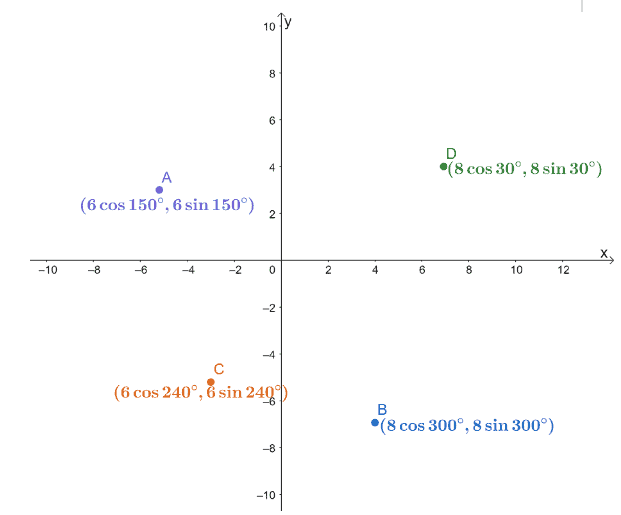
Notice the distances of the post-obit pairs of points.
a. Distance between $A$ and $C$.
b. Distance between $B$ and $C$.
c. Distance between $B$ and $D$.
Use the event to find which of the 3 segments, $\overline{AC}$, $\overline{BC}$, besides every bit $\overline{BD}$, are the shortest and the longest.
Solution
Nosotros tin can find the distances of all pairs by using the same altitude formula for polar coordinates as shown below.
\begin{aligned}d &= \sqrt{ r_1^{\phantom{x}two} + r_2^{\phantom{ten}ii} -2r_1r_2\cos(\theta_1 -\theta_2) }\end{aligned}
We can beginning with the showtime pair of polar coordinates: $A$ and $C$.
- $r_1 = 6$, $\theta_1 = 150^{\circ}$
- $r_2 = half-dozen$, $\theta_2 = 240^{\circ}$
Permit's enter these values into the altitude formula and have the following results:
\brainstorm{aligned}d &= \sqrt{ r_1^{\phantom{x}2} + r_2^{\phantom{x}2} -2r_1r_2\cos(\theta_1 -\theta_2) }\\&= \sqrt{36 + 36 -2(6)(6)\cos(240^{\circ}-150^{\circ})}\\&=\sqrt{72 – 72\cos 90^{\circ}}\\ &=\sqrt{72 – 0}\\&=\sqrt{72}\\&= half-dozen\sqrt{2}\end{aligned}
From this, we can see that the distance betwixt $A$ and $B$ is equal to $half dozen\sqrt{2}$ units or approximately, $8.49$ units. We can apply a similar arroyo to find the distances between b) $B$ and $C$ and c)$B$ and $D$. We can summarize the results in a table as shown below:
| First Polar Coordinate | 2nd Polar Coordinate | Distance | Guess Value |
| \brainstorm{aligned}B &= (viii \cos 300^{\circ}, 8 \sin 300^{\circ})\\r_1&= viii\\\theta_1 &= 300^{\circ}\stop{aligned} | \begin{aligned}C&= (half dozen \cos 240^{\circ}, 6 \sin 240^{\circ})\\r_2&= 6\\\theta_2 &= \cos 240^{\circ}\stop{aligned} | \begin{aligned}d &= \sqrt{ r_1^{\phantom{x}two} + r_2^{\phantom{ten}2} -2r_1r_2\cos(\theta_1 -\theta_2) }\\&= \sqrt{64 + 36 -two(8)(vi)\cos(300^{\circ}-240^{\circ})}\\&=\sqrt{100 – 96\cos lx^{\circ}}\\ &=\sqrt{100 – 96\cdot\dfrac{1}{2}}\\&=\sqrt{100-48}\\&=\sqrt{52}\\&=2\sqrt{13}\cease{aligned} | \begin{aligned}d &\approx vii.21\cease{aligned} |
| \begin{aligned}B &= (eight \cos 300^{\circ}, eight \sin 300^{\circ})\\r_1&= 8\\\theta_1 &= \cos 300^{\circ}\end{aligned} | \begin{aligned}D&= (viii \cos 30^{\circ}, viii \sin 30^{\circ})\\r_2&= 8\\\theta_2 &= 30^{\circ}\stop{aligned} | \begin{aligned}d &= \sqrt{ r_1^{\phantom{10}ii} + r_2^{\phantom{x}ii} -2r_1r_2\cos(\theta_1 -\theta_2) }\\&= \sqrt{64 + 64 -2(8)(viii)\cos(300^{\circ}-30^{\circ})}\\&=\sqrt{128 – 128\cos 270^{\circ}}\\ &=\sqrt{128 – 0}\\&=\sqrt{128}\\&=eight\sqrt{two}\finish{aligned} | \begin{aligned}d &\approx 11.31\end{aligned} |
Nosotros've shown you the distances between the ii pairs of points. Now, to reply the follow-up question, we tin compare the distances of $\overline{AC}$, $\overline{BC}$, and $\overline{BD}$.
\brainstorm{aligned}\overline{AC} &= 8.49\text{ units}\\\overline{BC} &= 7.21\text{ units}\\\overline{BD} &= 11.31\text{ units}\terminate{aligned}
Comparison the three, we can see that the longest segment will be $\overline{BD}$ and the shortest segment will be $\overline{BC}$.

Distance Between Two Polar Coordinates,
Source: https://www.storyofmathematics.com/distance-between-polar-coordinates/
Posted by: mapplocies.blogspot.com
0 Response to "Distance Between Two Polar Coordinates"
Post a Comment